Introduction | When Urgency Arrives by Text
Your phone buzzes with a message: “Your voter registration is at risk! Click now before it’s too late.” The text looks official, the link is right there, and you have a decision to make.
It’s election season in many parts of the world, and as our partners at Take9 point out, any high-profile event gives scammers an opening to rush people into acting before they think. Fortunately, the habits that protect you online all year also protect your vote and your wallet.
Why Election Season Is Scam Season
Scammers often plan around the calendar. Check Point’s 2026 U.S. Midterm Election Threat Outlook tracked about 4,010 newly registered web domains containing “vote” between April 13th and May 14th 2026, up from roughly 2,957 in January. Domains like these often host copycat voter portals and fraudulent donation pages. Check Point notes that a registration alone doesn’t prove bad intent, but the trend can show malicious actors preparing early.
We also tend to overestimate ourselves. The Global Anti-Scam Alliance found that 75% of European adults encountered a scam in the past year, while 71% felt confident they could spot one. A Consumer Reports, Aspen Digital, Global Cyber Alliance report found that 91% of American consumers have encountered at least one digital scam or cyberattack attempt and only 32% felt confident their sensitive data remained private.
Three Election Scams to Watch For
- “Your registration is at risk” messages – These texts and emails push you to fix your registration through a link. In July 2026, Rhode Island’s election division warned voters about one such phishing email.
- Fake donation requests. These mimic genuine campaign outreach and pressure you to give money or answer a quick survey. One phone-scam expert told KSNV in Las Vegas that the word “now” should immediately raise suspicion.
- Calls from “the election office.” A caller may ask for your ID number, banking details, or ballot ID. Voice cloning is more accessible than ever and this means that a voice you recognize is no longer proof of who is calling. In the U.S., the FCC made AI-generated voices in robocalls illegal in 2024 after cloned-voice calls targeted New Hampshire primary voters. Here’s more on how deepfakes and voice clones work.
Four Habits That Protect Your Vote and Your Wallet
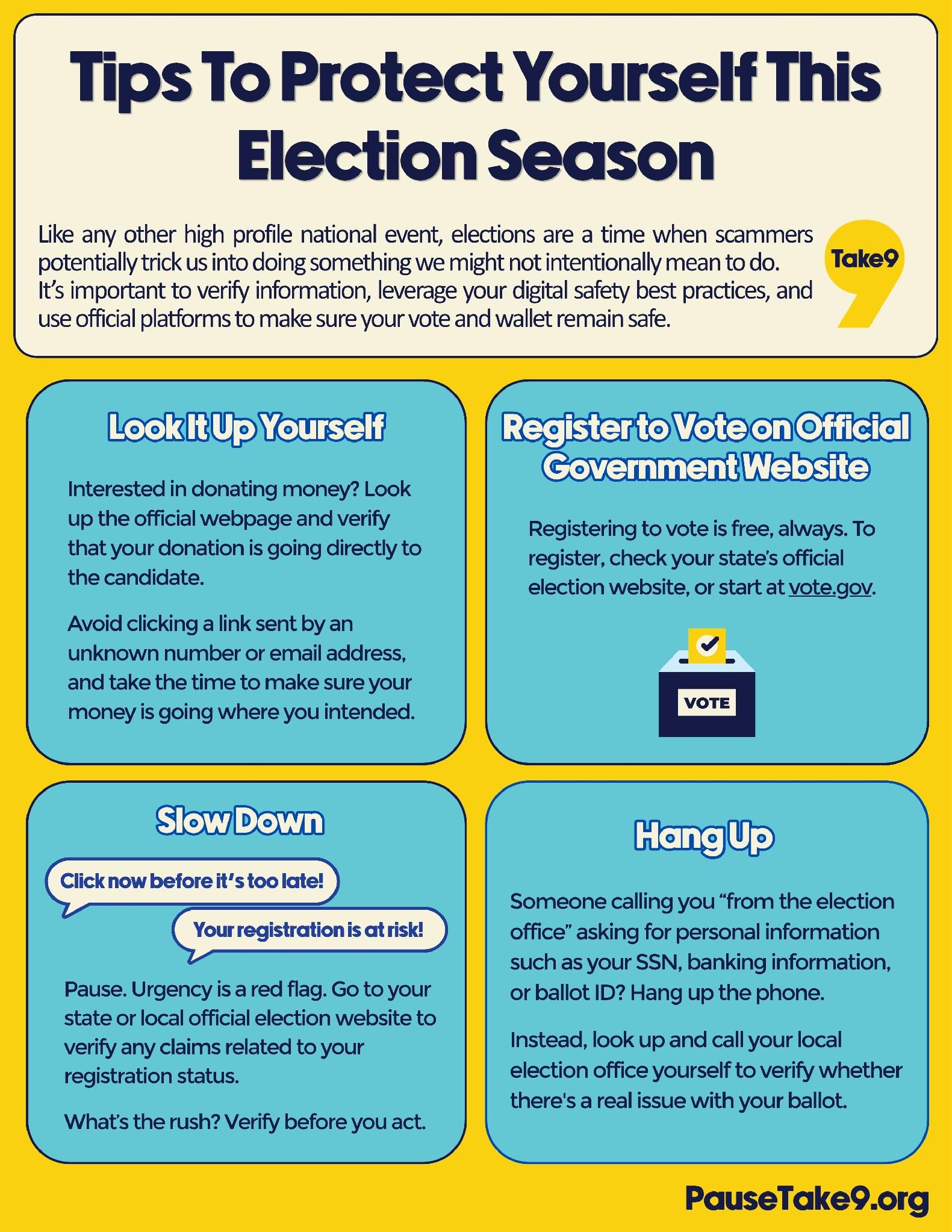
Take9 encourages a nine-second pause before you click, download, or share. Here’s how to put those nine seconds to work.
- Slow down – Urgency is the red flag. Before reacting, check any claim about your registration directly with your election authority, from the official government website and not from a link in the message.
- Look it up yourself – Want to donate? Type the campaign’s web address yourself and pay with a credit card or another method that offers fraud protection. In the U.S., the Federal Election Commission lets you confirm that a political committee is registered. For more on sending money online, read Pause Before You Pay.
- Stick to government websites – Registering to vote is always free. In the U.S., start at vote.gov or your state’s election website. Elsewhere, go to your country’s electoral authority. Bookmark it so you never need a stranger’s link.
- Hang up and call back – No legitimate election office needs your banking details during an unsolicited call. Find the number yourself and call back to confirm.
Secure the Accounts Scammers Want
Turn on multi-factor authentication for your email, bank, and any donation accounts. Email deserves extra attention, because it can be used to reset every other password. Use a different password for each account, and store them in a secure, encrypted password manager.
Check Point also found thousands of leaked logins tied to the fundraising platforms both major U.S. parties use. A protective DNS resolver like Quad9 adds another layer by blocking known malicious domains before they load. As we explained in the past, basic cyber hygiene still does most of the work, even as AI changes the threats.
Election Scams FAQ
How can I tell if an election text or email is real?
Skip the link and check your status on your election office’s website. Some offices do send reminders, but a request for payment or banking details is a sign of a scam.
Can scammers really fake an election official’s voice?
Yes. The technology is widely available, so hang up and call back on a number you look up yourself.
Where do I report an election scam?
Start with your local election office. In the U.S., you can also report it to the FBI’s Internet Crime Complaint Center (IC3). GCA’s toolkit lists more places to report cybercrime and get help. GASA found that only 3% of European adults and 4% of U.S. adults report scams to authorities, so every report helps.
Is it safe to donate to a campaign online?
It can be. Go to the campaign’s website directly rather than through a link in a text or email, and pay with a credit card, which usually offers better fraud protection than a debit card or crypto payment. If a message pressures you to give “now,” treat that as your cue to slow down.
What should I do if I already clicked a link or shared information?
Stay calm and move quickly. If you shared banking or card details, contact your bank right away. Change the password for any account you entered on the suspicious page, and turn on multi-factor authentication if it isn’t already on. If you shared an ID number, use your government’s identity theft resources (in the U.S., that’s IdentityTheft.gov). Then report the scam so others can be warned.
The Takeaway | Nine Seconds for Democracy
Think back to that text message we mentioned in the beginning of the article. Scammers sell urgency, because it works. Elections run on something slower and far more valuable: trust.
Every scam that lands costs someone money or privacy, and it chips away at confidence in the process itself. That’s why we believe cybersecurity is the backbone of democracy. Election officials protect the ballot box. Voters protect the inbox.
Share these habits with one person likely to be targeted, such as a parent, grandparent, or first-time voter. Then visit the GCA Cybersecurity Toolkit for Individuals for steps that keep you safer this election season and long after it ends.
Casting a ballot takes a few minutes. Protecting it takes nine seconds.