Spotlight
GCA's Work on Artificial Intelligence
Artificial Intelligence (AI) brings enormous opportunity—but also new risks that affect us all. We’re helping educate the next generation of business leaders about AI’s impact and developing tools that empower everyone to stay safe and secure in an AI-driven world.

Training Tomorrow’s Defenders: Growing Cybersecurity Capacity in a World of Cheaper, Faster Attacks
GCA launched a new AI and cybersecurity curriculum that transforms university students from passive learners into solution builders. Designed to strengthen global cybersecurity capacity, the program gives students practical skills, strategic insight, and real-world experience addressing the risks and opportunities of AI.
Through three core modules—covering criminal misuse, responsible AI use, and securing no-code/low-code platforms—students gain a 360° understanding of AI’s impact. The pilot program at Carnegie Mellon University Africa produced innovative student-built tools, including AI chatbots for cyberbullying prevention and cybersecurity tutoring. Future modules will continue to emphasize hands-on application and tool building to support capstone project development, ensuring the initiative remains practical, current, and directly tied to real-world workforce needs.
About Our Work on AI
Rapid advances in AI have created powerful new opportunities for both good and evil. Criminals can now use generative AI (genAI) to launch highly convincing scams, deepfakes, and other cyberattacks at unprecedented scale, lowering their costs and speeding up their operations. Anyone, regardless of technical skill, can become a target. Small businesses and nonprofits are especially vulnerable, often lacking the staff, time, and expertise to assess and manage cyber risks. Traditional cybersecurity training is often too often expensive, overly complex, or scattered, leaving these organizations exposed.
GCA works to create a safer digital ecosystem for everyone. We translate complex cybersecurity concepts into plain language and practical steps, delivering free, easy-to-use solutions to small businesses, nonprofits, and other overlooked groups. When the most vulnerable are protected, the entire digital ecosystem gets stronger.
Our GCA Cybersecurity Toolkits now include an “Artificial Intelligence User Security Guide.” Plus, we are working toward using AI to automate the full lifecycle of our training and resources. By integrating AI into our work, we can provide tailored, accessible resources to more people in more places than ever before.
Cybersecurity is a shared responsibility. Whether you’re a small organization under threat of attack or a large enterprise working to secure your supply chain, we invite you to be part of this effort to make cybersecurity more accessible, equitable, and effective for all. By acting now, we can unleash AI’s positive potential, safeguard critical organizations, and strengthen the security of the Internet for everyone.
“Attitudes toward AI in education closely resemble those seen during the introduction of the calculator into the classroom in the early 1980s. We’ve witnessed a wide range of responses—from full acceptance to strong resistance—regarding its role as a learning tool. Yet, just like the calculator, AI challenges us to rethink how we learn, build, and teach. This transformation is still unfolding across all levels of education, from kindergarten to foundational college programs.”
Lenah Chacha, Carnegie Mellon University Africa
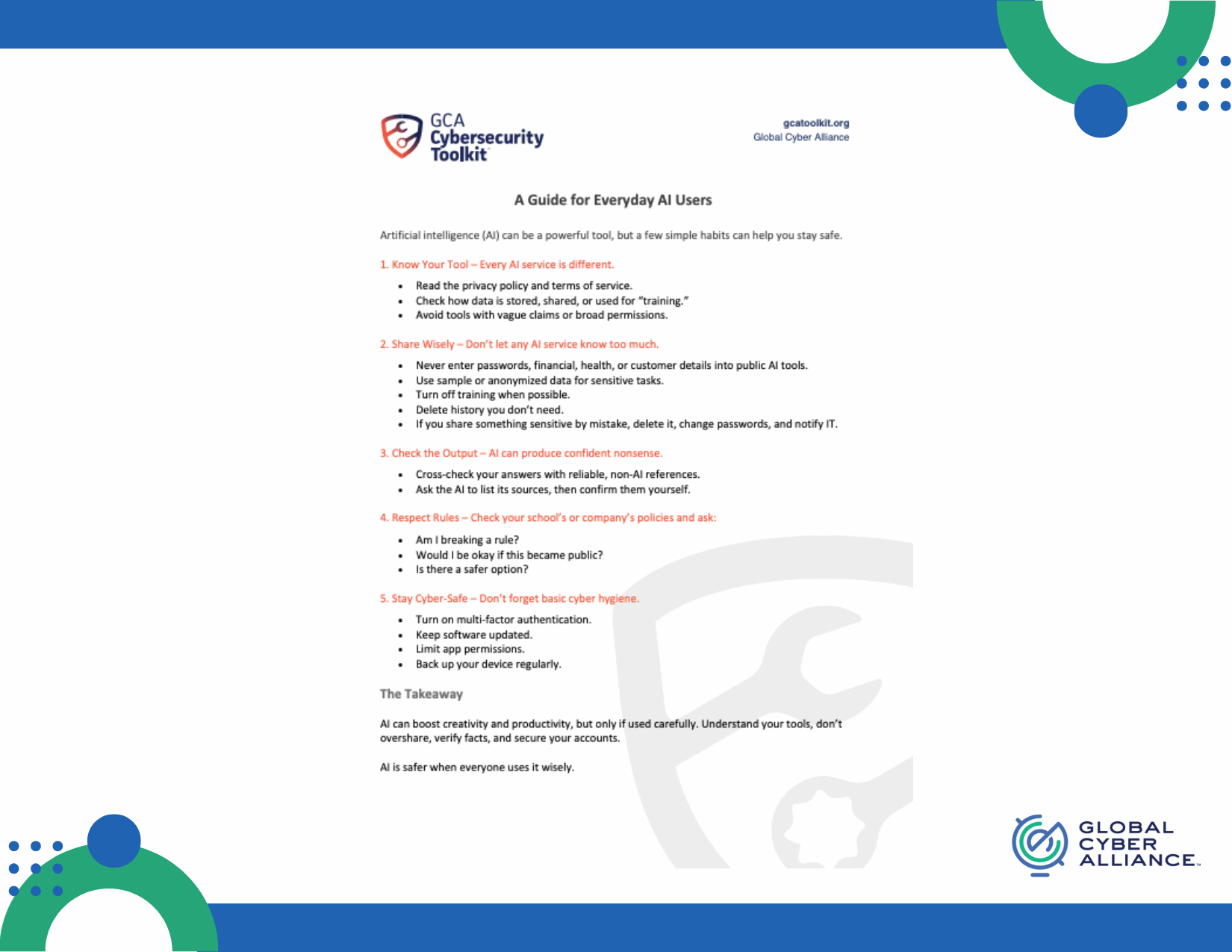
Featured Resource: Artificial Intelligence User Security Guide
Before using artificial intelligence (AI) it is important to understand what you’re using, limit what you share, check the output, and keep your devices and accounts secure.
The Global Cyber Alliance has developed this downloadable one-pager to help you stay safe online when using AI.

Artificial Intelligence News
Brian Cute on the Software Spotlight Podcast

The Trust Crisis: How AI is Changing Cybersecurity. The Cybercrime Inflection Point

Cybersecurity Beyond Blocking: A Call for Collaboration

Brian Cute on the Techsequences Podcast

Don’t Pack a Scam | How to Travel Smart in a Digital World

AI Experience Podcast: The Coming Tsunami of AI-Powered Scams

AITech Park Interview: A Safer Internet in an AI-enabled World

Recapping the India AI Impact Summit: Turning AI Risks into Cybersecurity Opportunity

Introducing the 2025 Annual Report: Strengthening the Internet, Protecting People

Podcast: Cyber Resilience for Small Enterprises

Why Good Cyber Defense Rarely Stops Attackers

Too Perfect to Be Real | AI and Modern Romance Scams

Global Voices with Kitboga: “Be careful trusting what you see online, especially if someone is asking for money or your information.”

Before the AI Cybercrime Wave

Five Cybersecurity Forces That Defined 2025 – And Will Shape 2026

Building AI Tools That Matter: Inside the Student Experience at CMU Africa
Spotlight: Artificial Intelligence

The AI-Scam Crisis: Why We Must Act Now

Training Tomorrow’s Defenders: Growing Cybersecurity Capacity in a World of Cheaper, Faster Attacks

Don’t Forget Your Digital Sunscreen | A Guide to Safely Swimming in the AI Pool

From the Classroom to the Real World: GCA Interns’ Reflections on Building a Safer Internet

Seeing Isn’t Believing | Staying Safe During the Deepfake Revolution

Bfore.AI’s PreCrime Threat Intelligence Takes Domain Trust to a New Dimension