
Introduction | Welcome to the AI Wave
Artificial intelligence (AI) is everywhere now, from chat assistants to writing aids to tools integrated into classrooms and workplaces. Adoption is rising rapidly. A 2024 survey by McKinsey & Company revealed that 78 percent of respondents reported their organization uses AI for at least one business function. Another study by AltIndex estimates global AI adoption will rise by 20% by the end of 2025, reaching 378 million users. The advantages delivered by AI also come with responsibilities. Think of “digital sunscreen” as the basic protection you apply before using any AI tool. It is important to understand what you’re using, limit what you share, check the output, and keep your devices and accounts secure. That’s why the Global Cyber Alliance has decided to create a guide for safely swimming in the AI pool.
Know What’s in the Water | Understand the AI Tool You’re Using
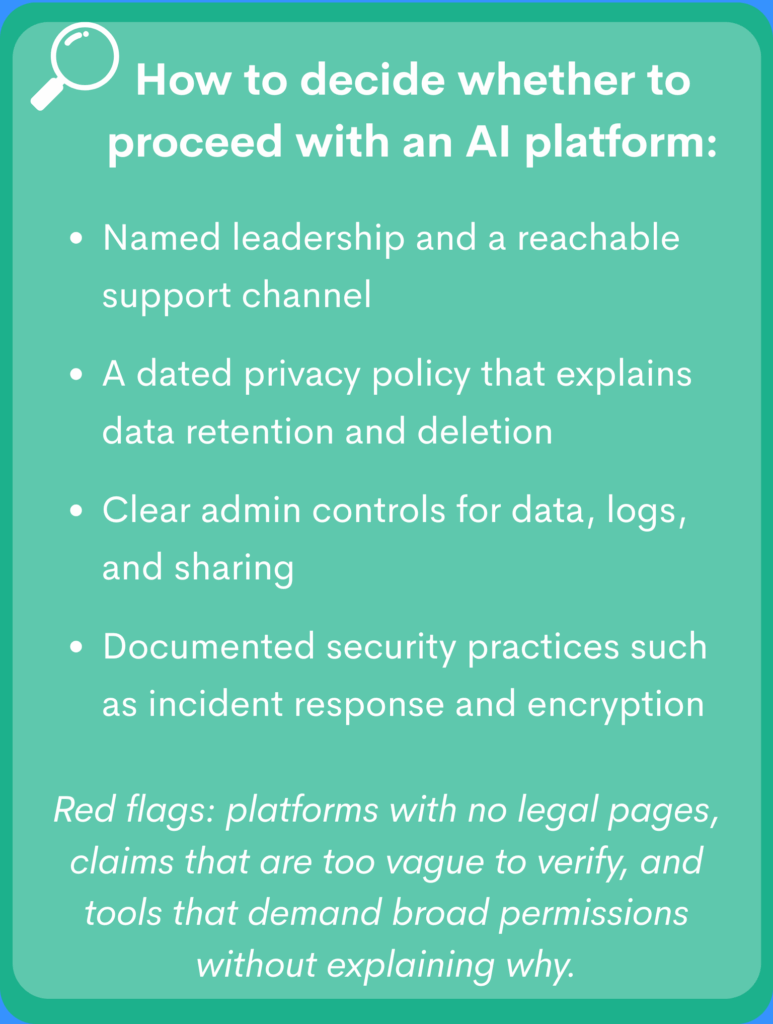
AI platforms differ in how they work and how they treat your data. Some generate text or images. Others classify, summarize, or search across your files. Before incorporating any AI tool, it is essential for your cyber hygiene to spend a couple of minutes learning how it operates and, more importantly, how it handles data.
Always begin by reading the terms of service and the privacy policy. These documents can be boring and long-winded, but knowing how a company is handling your information can pay dividends. Look for plain statements about what data is collected, how long it is kept, whether it is shared, and if you can opt out of allowing your data and content to improve the AI (called “model training”). If the service offers an enterprise or educational tier, compare the data commitments with those of the free tier. If you cannot find basic information about the business or its leadership, it might be time to take a step back and look for a similar platform that offers more transparency.
Don’t Overshare in the Pool | Being Mindful of What You Input
Continue treating AI like any other third-party service. Many systems retain prompts and responses to improve models, even if the company says the data is anonymized. You should never paste passwords, health or financial details, customer data, trade secrets, or any other personal data into a public AI tool. Policies can change, companies get acquired, and data that is safe today may be handled differently tomorrow.
If you must work with sensitive material, sanitize it first. Strip names, IDs, addresses, client references, and any unique business context that might reveal proprietary information. When possible, test ideas using synthetic or public sample data. Consider employer-approved or local AI options for truly sensitive workflows. The risks are real: in 2023, Samsung banned the use of ChatGPT and similar AI tools due to a leak of sensitive source code after an employee was found to be using ChatGPT for work-related tasks.
Reapplying Digital Sunscreen | The Importance of Fact Checking AI Outputs
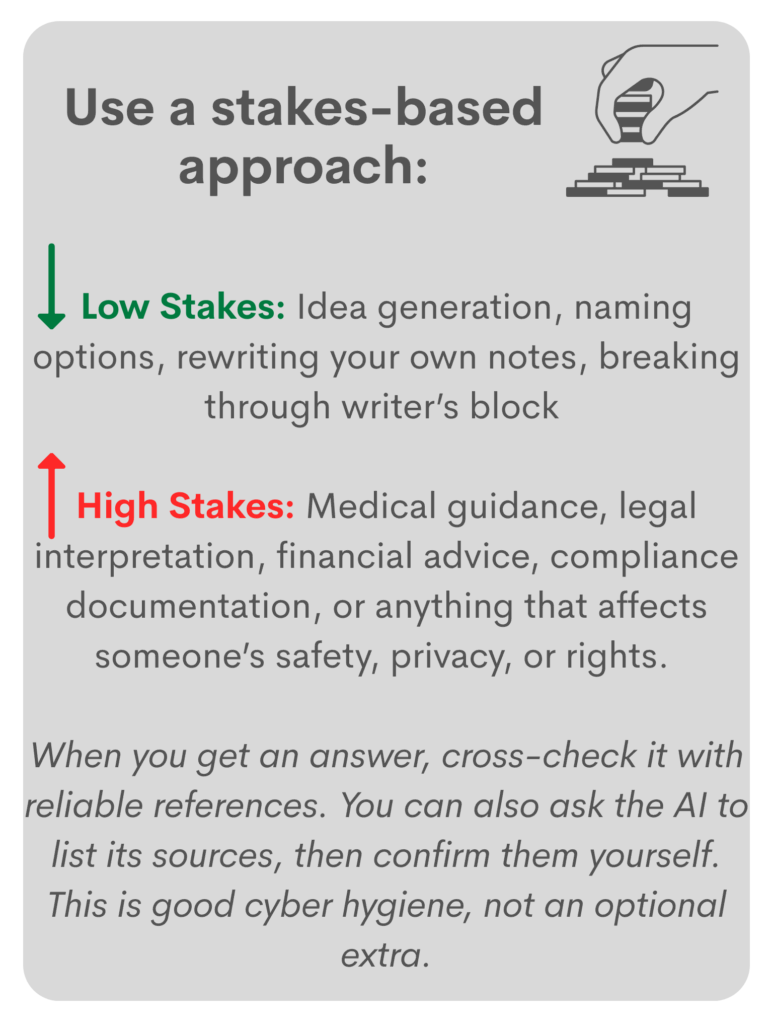
AI can produce confident nonsense. One essential concept that AI users should take the time to understand is that large language models (LLMs) don’t “think” in a human sense, they synthesize patterns from data. That makes them powerful for brainstorming, summarizing, and drafting, yet risky when accuracy matters. When working with AI, it can help to categorize your questions or “prompts” into two levels: low-stakes & high-stakes. By doing this, you will better position yourself to know how much scrutiny should be applied to the AI’s output. A low-stakes use case can help you come up with fresh ideas and save time. A quick skim with less fact-checking and data validation is typically sufficient with these types of prompts.
On the other hand, high-stakes prompts should lead to verification of facts with an authoritative source or consulting with a qualified professional before moving forward with any advice. Also, ask your AI platform for sources to help validate the output and confirm the provided sources yourself. In these circumstances, you should never rely solely on AI. Adopting the mindset of classifying AI prompts as low- or high-stakes should be treated as mandatory cyber hygiene.
Digital Sunscreen for School & Work | Ethical AI Use
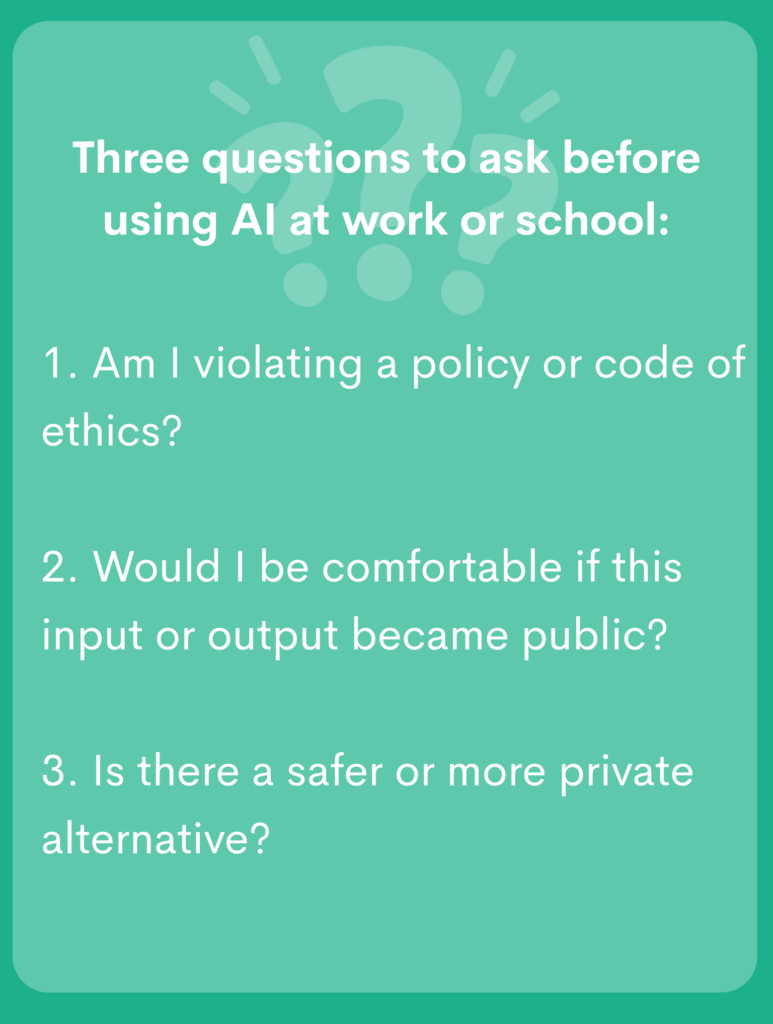
Know the rules where you learn and work. Most schools and employers now have AI policies that address plagiarism, disclosure, and acceptable use of data. If those guidelines don’t exist, ask a manager or instructor how they want AI used and what is off limits. There are often preconceived notions that using AI as a working tool will diminish your capabilities as a student or employee. However, by normalizing transparency in AI use, we can break these notions and re-establish the idea that AI, as a revolutionary tool, is similar to the transition from snail mail to email. In other words, when used responsibly, it should serve as a means of time and information optimization, not a replacement for intuition and autonomy.
In the workplace, a company’s obligations to customers and partners also apply to AI tools. Customer data, source code, and confidential documents should never be pasted into public systems. Remember the Samsung incident as a cautionary tale about how quickly sensitive information can escape once it enters a public model.
Protect Your Devices & Accounts | AI Use Still Requires Good Cyber Hygiene
AI use does not replace basic cyber hygiene practices. In fact, AI use makes those fundamentals even more important. Below is a checklist of items that you should incorporate into your digital life, regardless of whether you’re using AI. However, for those who are diving into the AI pool, following these cyber hygiene best practices should be considered non-negotiable.
- Enable multi-factor authentication (MFA) for every account you can, especially the email and other accounts connected to AI tools.
- Keep systems updated. That includes browsers, AI plug-ins, and any extensions. Malicious or compromised extensions can be used to steal sessions and data, while outdated operating systems can lack security vulnerability patches.
- Be careful with AI browser extensions or agents that promise automation. Independent security groups and vendors have documented risks ranging from hidden data collection to code injection.
- Create a backup schedule for your devices and stick to it. Having a recent and clean backup of your system can save you a lot of headaches if your system crashes or is compromised.
- Limit app permissions. If there is no need for an app or platform to access your entire photo album or know your location at all times, then only provide access to that information when needed.
- Always read privacy policies and terms of service, and review them regularly for updates.
For stronger passwords and account practices, start with trusted guides or toolkits that explain password managers, passphrases, and multi-factor options in plain language. The Global Cyber Alliance Cybersecurity Toolkit has become the trusted-resource for many users to ensure they’re staying safe online.
Understand the Fine Print | Keeping Your Data YOURS
As mentioned, many AI platforms allow users to turn off model training on your content and data. Learn where that switch lives and use it when available. Sometimes, this may be as simple as asking the AI platform itself how to change these configurations. Once found, review settings for chat history, export, and delete. If you are a system administrator, set default retention to the shortest period that still supports your work. Schedule periodic reviews of logs and shared chats. Make it easy for users to request deletion when they make a mistake in a prompt.
If sensitive information was pasted into a public tool, act quickly. Remove the content if the interface allows it. Change related passwords and keys. Depending on the nature of the data shared and your company or school’s policies, you may even go as far as to notify your organization’s IT contact or privacy officer so they can log the incident and determine whether further action is needed. Treat it as a learning moment by updating guidance so others can avoid the same mistake.
The Takeaway | Swimming Safely with AI Isn’t About Paranoia, It’s About Peace of Mind
AI is setting the stage to become one of this generation’s most impactful technological advances. It can boost creativity, productivity, and learning. AI isn’t something we should fear; in fact, we should embrace its endless possibilities. However, before you dive into the AI pool, don’t forget to put on your digital sunscreen to protect your privacy, safety, and data – your future self will thank you. The smartest and most proficient AI users aren’t just curious, they’re also careful. They understand what tool they’re using, they avoid oversharing, they verify important claims, and they keep accounts locked down. That care is what turns an exciting new tool into a lasting advantage.
Share this guide with your team, family, and community. Safer AI use becomes much easier when everyone around you knows the basics.