With the transformation into an AI-driven society comes a growing need for professionals who understand its potential and its risks. That’s the vision behind GCA’s new AI+Cyber Curriculum, an initiative to teach students about AI safety and equip them to build real, deployable solutions before they graduate. Launched with a pilot cohort of ten STEM students at Carnegie Mellon University Africa, the program blends technical foundations, responsible-use frameworks, and hands-on capstone projects that mirror real-world cybersecurity challenges.
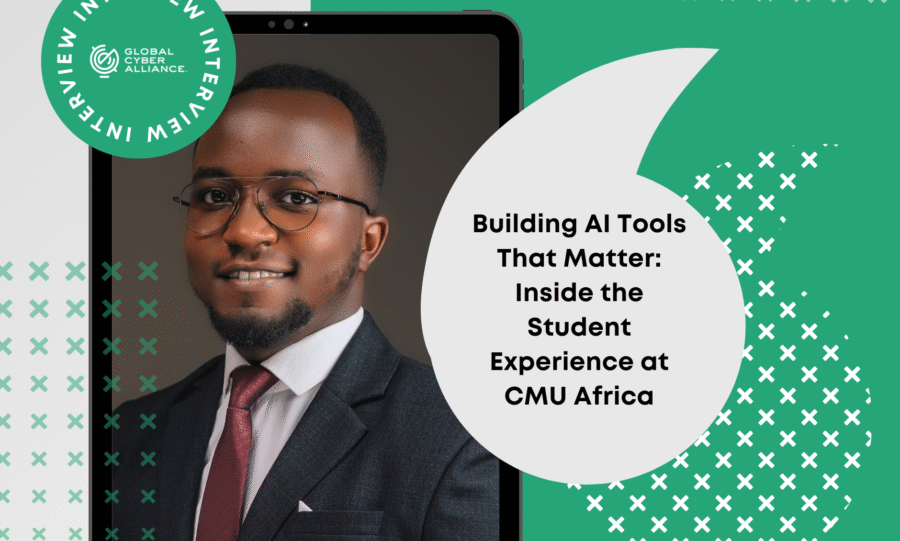
We had the opportunity to chat with Joseph Ineza Karangwa, one of the students in the pilot project. He helped shape the first set of student-built tools emerging from the curriculum. In this interview, we’ll explore what drew him to the program, what he built, challenges he faced, and how he sees AI shaping the cybersecurity landscape of the future.
What inspired you to take the course and complete a capstone project on AI and cybersecurity?
My inspiration stemmed from a clear observation: cyber threats are evolving at an unprecedented pace, largely driven by AI. Traditional learning methods often struggle to keep up, leading to a significant skill gap. I saw that platforms like picoCTF are great, but beginners often get stuck because the material can be overly technical and lack real-world context. This highlighted a critical need for more accessible, adaptive, and engaging education in cybersecurity. My goal was to leverage AI itself to empower the next generation of defenders, making complex topics understandable and practical.
What specific problem is your chatbot trying to solve, and how does the bot work?
The chatbot addresses the problem of fragmented, overly technical, and context-lacking cybersecurity education. It aims to be a 24/7 tutor that guides, explains, and supports learners across any platform. Essentially, it works by providing clear, plain-language explanations of complex cybersecurity concepts, adapting to the user’s experience level and the specific platform they are using. It also connects these lessons to real-world attacks, making the learning much more relevant and engaging. Think of it as an intelligent study buddy that simplifies jargon and offers personalized support, ensuring beginners can navigate challenging concepts with less frustration.
What was your most challenging technical hurdle, and how did you solve it?
My most challenging technical hurdle was the content processing complexity, specifically handling the diverse and sometimes inconsistent formats of the educational materials. We were dealing with multiple content types, like AsciiDoc and Markdown for challenge data, each with its own quirks. AsciiDoc, for instance, required custom regex patterns just to correctly identify sections, and heading structures varied wildly. This meant I couldn’t use a single parsing strategy.
My solution involved developing separate, specialized content processors for different material types. For AsciiDoc, I implemented custom Python modules with tailored regex to accurately extract structured information. For other content, I refined parsing logic to ensure consistent data extraction. This allowed us to convert all these varied formats into coherent, embedded vectors stored in ChromaDB, enabling the chatbot to perform accurate, context-aware semantic searches regardless of the original source. It was critical for providing our AI with a unified, searchable knowledge base.
Looking ahead, where do you see the most significant opportunities for AI to impact cybersecurity positively?
I see immense opportunities for AI to positively impact cybersecurity, primarily in two key areas. First, proactive defense and threat intelligence. AI can analyze vast amounts of data far quicker than humans, identifying emerging threat patterns, vulnerabilities, and anomalies before they become major incidents. This shifts us from reactive to predictive security. Second, democratizing cybersecurity education and making it more accessible. As my project aims to do, AI can personalize learning experiences, making complex topics digestible for a broader audience. This can help close the skill gap and build a stronger, more knowledgeable defense workforce globally. The future is about AI augmenting human capabilities, not replacing them, especially in critical fields like cybersecurity.