Readout from the 13th Domain Trust Community Meeting
On March 25, the Domain Trust Community convened its 13th consecutive quarterly meeting — a milestone that marked both continuity and a turning point. This session was especially significant, as members made a critical decision about the future direction of the initiative — moving forward with the technical development proposal first introduced in late 2024. This step follows a successful round of one-on-one consultations with twelve key stakeholders. Their support — and, in some cases, genuine enthusiasm — helped solidify confidence in this next phase.
“Do Something. Measure it.” – A Turning Point for Domain Trust
GCA’s motto is “Do Something. Measure It.” and so we aim to do just that with Domain Trust. At its core, the technical development proposal aims to transform Domain Trust into an “observatory of action.” In this model, stakeholders in the domain abuse ecosystem will collaborate to define a baseline set of actionable practices, practices that are not only impactful but also objectively measurable. The new focus can be summarized in three powerful words — agreement, action, and measurement.
Building on Strong Foundations
This shift is not a revolution, but rather a natural evolution of the initiative.
It builds upon years of collective work, including the growth of a vibrant community of over 100 participants and an increasingly open information-sharing repository that now tracks more than 32 million unique domains, with close to 1 million new entries added each month.
The technical development proposal also aligns with the broader goals of GCA’s Internet Integrity Program, which seeks to rally Internet infrastructure operators for effective change in their corresponding spheres of action — across Names, Numbers, and Routes (i.e., domain names, IP addresses, and routing).
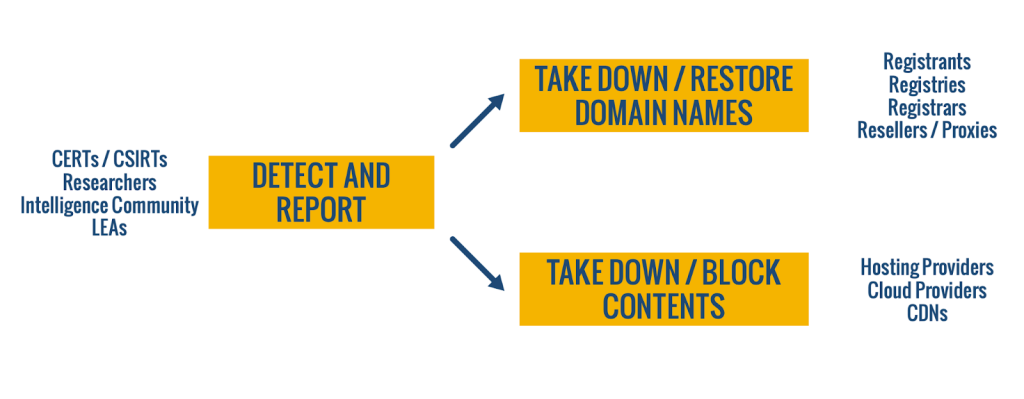
Another key aspect is a focus on “communities of action,” the actors with the power to drive meaningful change. In our model, that includes the domain registration community (registrants, registries, registrars, and resellers/proxies) and the hosting services (hosting providers, cloud providers, and CDNs).
This focus will facilitate achieving realistic agreements and identifying relevant metrics and indicators, while letting GCA play the role it has been designed to play, that of a neutral convener and trusted builder of action-oriented initiatives. That trust is fundamental in a packed environment such as that of the fight against domain abuse.
Implementation: A Community-Led Effort
Implementation begins through a dedicated working group reporting quarterly to the full community. The first phase concentrates on the domain registration community, with a pilot group of registries and registrars that have already committed time to the journey. Their understood, shared challenge— to establish baseline agreements that are realistic and inclusive. The pilot group will aim not for perfection, but broad participation within the domain ecosystem, including by “poor performers.”
This group, which remains open to new members (especially registrars), will be supported by GCA in a secretariat role, as well as by experts from the “detect and report” community (CERTs, CSIRTs, researchers, intelligence professionals, and law enforcement).
A key deliverable will be to agree on an objectively measurable framework that will eventually lead to a Domain Trust badge (or similar mechanism) — a potential incentive for adoption based on reputation, economic benefits, or even as a strategy to preempt regulatory pressure.
Vibrant Discussion and Community Insight
During the meeting, participants engaged in thought-provoking and insightful discussions on the technical development proposal — incentives for change, the challenge of measuring impact with accurate metrics, and the complexities of acting against domain abuse. One particularly eye-opening resource shared during the discussion was this CIRCL link on abuse mitigation challenges.
Another hot topic was the ongoing impact of ICANN’s contractual amendments, with members referencing several valuable materials, including:
- A NetBeacon Institute report: How have the gTLD contractual amendments impacted DNS Abuse?
- A NetBeacon Institute case study: How Did the Closure of Freenom Impact DNS Abuse Across the TLD Ecosystem?
- ICANN’s detailed analysis of abusive domain characteristics: INFERMAL Project: Analyzing Features of Malicious Domain Registrations
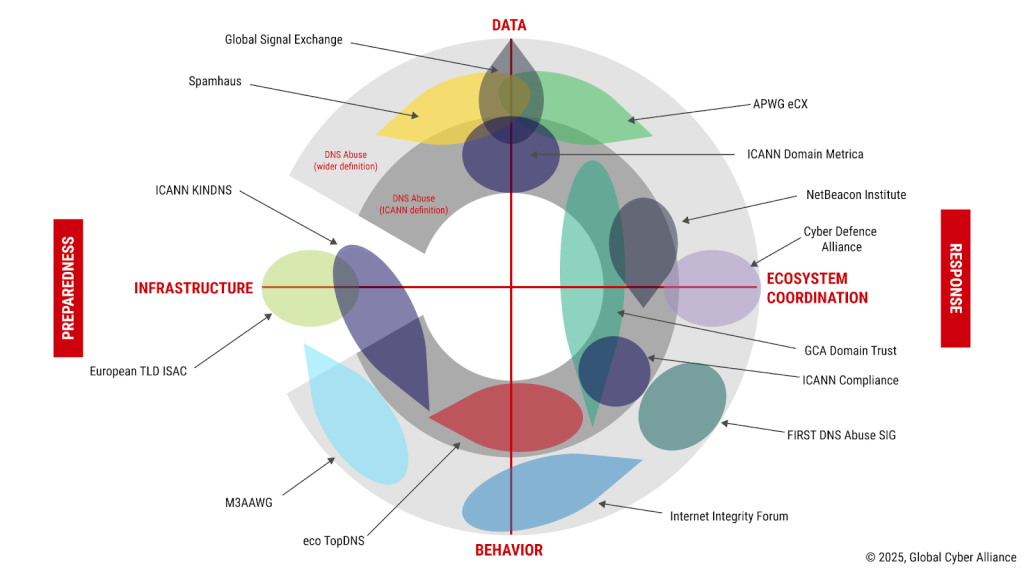
The recent launch of the Internet Integrity Forum (IIF), introduced at an eco TopDNS meeting in Amsterdam last February, also sparked interest. Several IIF representatives joined the Domain Trust session, offering insights into their emerging work. The IIF has since been added to our growing Ecosystem Map — a visual snapshot of global initiatives combating domain abuse, now in its third version.
Looking Ahead
As this new technical path takes shape, Domain Trust remains committed to expanding its impact. Enhancements to data usability and visibility will continue, alongside outreach efforts to bring in new participants through geographically focused campaigns.
Data access will remain free for all qualified users, regardless of size. Still, the community will begin exploring long-term financial sustainability.
Expect future quarterly gatherings to also focus on data enhancements, registrar and hosting community growth, and financial sustainability strategies.
Join Us
The March 25 meeting brought together 55 participants from 36 organizations and 18 countries, reflecting the truly global nature of our community.
The next Domain Trust Community Meeting is scheduled for June 3 — and we would love to see you there. If you like what you have just read and are committed to the fight against domain abuse, please reach out to us to get started!