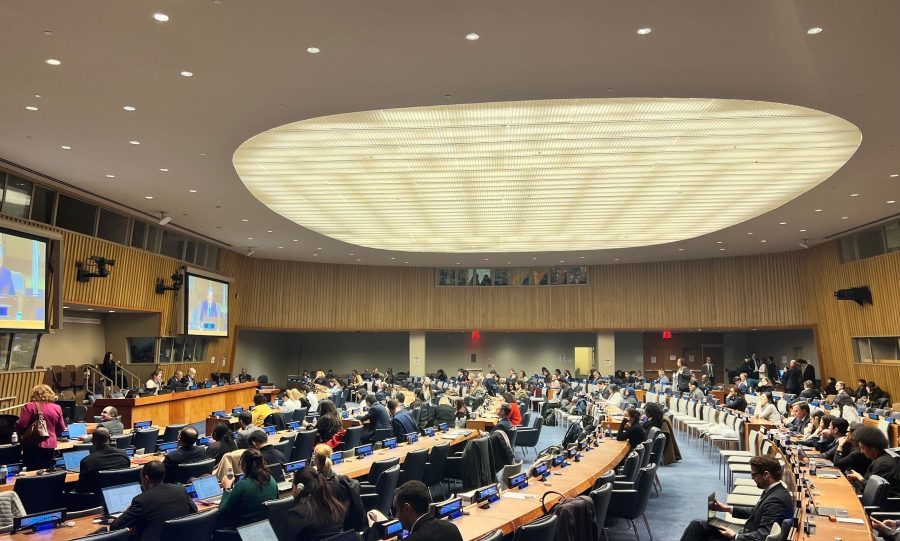
19 February 2025
Thank you Chair for giving me the floor – again.
Distinguished Delegates and Esteemed Colleagues,
This time I am speaking in my role as Director of the Common Good Cyber initiative led by the Global Cyber Alliance.
We support the statement made by the European Union Institute for Security Studies, and we draw your attention to the vital contributions of nonprofit organizations to global cybersecurity. They provide essential tools and services, most often at no cost to the user, benefiting diverse actors, including critical infrastructure operators and underserved populations.
Over the past year, and with the support of the UK FCDO and the EUISS, Common Good Cyber conducted a review of the cybersecurity tools, services, and platforms deployed in the public interest to secure networks, empower Internet users, and increase resilience across sectors. This mapping is available on commongoodcyber.org. Out of the 334 solutions identified, 162 are maintained by nonprofit organisations, for example:
- By becoming the secretariat of MANRS (Mutually Agreed Norms for Routing Security), the Global Cyber Alliance has ensured a stronger, more secure routing system worldwide. It achieved a 12.5% growth in participation in 2024, expanding from 1,071 to 1,190 participants.
- The Shadowserver Foundation provides free daily alerts about vulnerabilities to over 9,000 organizations, such as hospitals, NGOs, schools, and critical infrastructures, enabling timely security interventions.
- The CyberPeace Institute’s CyberPeace Builders program connects NGOs with cybersecurity professionals, and supports 437 NGOs in 121 countries for free, to enhance their security posture and mitigating breaches.
Despite their outsized impact, nonprofits still face hurdles, such as limited recognition of their contributions and funding shortages, that hinder their ability to participate in multilateral policy forums like the OEWG – point proven by my delivery of three statements this afternoon. As the OEWG is moving toward the implementation of a permanent mechanism, we welcome the Canada-Chile paper for multistakeholder engagement, and make the following recommendations:
- Simplifying engagement processes: Streamlining requirements for nonprofits’ participation in the OEWG, like accreditation procedures.
- Providing financial and logistical support: Offering hybrid options, or travel and logistical funding to encourage participation.
- Facilitating knowledge sharing: Promoting solutions repositories, such as the Common Good Cyber mapping, to prevent redundancy and promote cooperation.
- Fostering meaningful contributions: Holding solutions-oriented workshops and 1:1 meetings where nonprofits can present insights and share expertise on specific themes alongside national representatives.
By recognizing and empowering nonprofits as partners and reducing barriers to their participation, the OEWG can strengthen collective cyber resilience and create a safer, more equitable digital world that serves humanity’s shared interests.
We thank you for your consideration of this critical issue and look forward to continuing our collaboration in pursuit of a secure and inclusive cyberspace.
The Common Good Cyber Secretariat wishes participants in the tenth substantive session of the Open-ended Working Group on security of and in the use of information and communications technologies (2021–2025) a productive meeting.