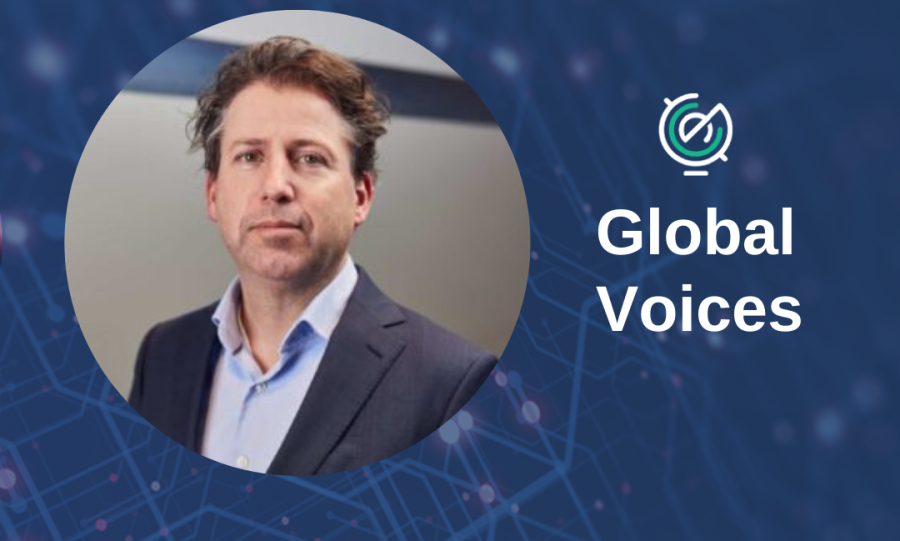
We interviewed David van Duren, the Director of the Global Forum on Cyber Expertise (GFCE) Secretariat since the official launch in 2015, about his views on Common Good Cyber, the just-concluded GC3B 2025 Conference in Geneva, and the organization’s milestones, impact, and priorities ahead.
Congratulations on your 10th anniversary this year! What are your biggest accomplishments so far toward fulfilling your mission, and what do you expect in the next ten years?
Over the past decade, the Global Forum on Cyber Expertise (GFCE) has evolved from a modest initiative into the leading global platform dedicated to cyber capacity building. At the heart of this transformation lies our most enduring accomplishment: the cultivation of a trusted, multi-stakeholder community. Today, that community spans over 250 members and partners — bringing together governments, international organizations, the private sector, civil society, and academia to work collectively toward strengthening global cyber resilience.
This shared commitment has translated into concrete progress. We have built and maintained a neutral coordination platform that facilitates collaboration between donors and recipients, accelerates support where it is most needed, and helps prevent duplication of efforts. We launched the Cybil Knowledge Portal — now the world’s most comprehensive repository of cyber capacity building resources. Through the establishment of regional hubs, we brought coordination closer to the ground and aligned efforts with local realities and priorities. And with the formation of Working Groups and Communities of Practice, we created spaces for meaningful, cross-regional collaboration on key thematic issues.
More recently, the establishment of the GFCE Foundation and the Strategic Steering Committee marked a significant milestone — anchoring our governance in the very community we serve and laying the groundwork for a more sustainable operational model.
As we look ahead, our priority is to deepen regional action, scale support through new and strengthened partnerships, and secure the long-term viability of our core services. The next decade will demand a more agile GFCE — one that remains responsive to global shifts, attuned to national and regional needs, and firmly rooted in shared responsibility. In a world marked by increasing fragmentation, our mission remains clear: to empower our community to act together, driven by purpose and unity, to build an open and secure digital future.
Among other achievements, you launched a truly global conference, GC3B, which last year was held in Africa with an ambitious call to action: The Accra Call. What is your assessment of its success and what do you expect from this year’s event in Geneva?
The Global Conference on Cyber Capacity Building (GC3B) was created to serve as a global convening space dedicated specifically to cyber capacity building. The last edition was hosted in Accra by the Ministry of Digitalisation and Communications of Ghana through its Cyber Security Authority (CSA), and co-organized by the World Bank, the CyberPeace Institute, the World Economic Forum and the GFCE. It was a landmark moment for the field — not only because it was the first time such a global event was held on the African continent, but because it produced a shared and inclusive vision for the future: the Accra Call for Cyber Resilient Development.
The Accra Call was significant because it was not a declaration made by a small group — it was endorsed by +78 countries, organizations, and stakeholders from across sectors and regions — including an endorsement and pledge by the Global Cyber Alliance. It helped place cyber resilience squarely within the broader development agenda and gave a collective voice to the priorities and principles that should guide cyber capacity building going forward.
Since its launch, the Accra Call has been referenced by donors, implementers, and multilateral actors as a common framework for aligning efforts. It also created momentum for stronger cooperation and integration with development stakeholders, including multilateral development banks and UN bodies.
AtGC3B 2025 in Geneva, our aim is to maintain that momentum while addressing the growing demand for coordination and impact. This year’s event will focus on implementation: how we move from shared principles to concrete action, scale up efforts in underfunded regions, and build sustainable partnerships across sectors. It will also feature a dedicated space for regional voices and provide updates on how the Accra Call is being translated into practice.
You have been part of the secretariat for Common Good Cyber, where together we strive to achieve a sustainable funding model for the actors who ensure security on the Internet. As a nonprofit yourself, what difficulties have you encountered since GFCE’s creation and what would you like to achieve with Common Good Cyber for the wider ecosystem of cybersecurity nonprofits?
The GFCE was established with a public good mandate: to serve as a neutral platform that connects countries, organizations, and regions to advance cyber capacity building globally. Yet, like many nonprofits in the cybersecurity space, we have consistently faced a paradox — our role is recognized as essential, but our funding has often been short-term, fragmented, or tied to narrowly defined projects.
This challenge is not unique to the GFCE. Many organizations that provide foundational services — from coordination and knowledge sharing to technical assistance — struggle to access sustainable, flexible funding. These services may not always produce visible or immediate outputs, but they are critical to enabling long-term impact and avoiding duplication of efforts across the ecosystem.
Through Common Good Cyber, we aim to address this systemic issue by making the case for sustained investment in those actors that serve the broader cybersecurity community. Our goal is to develop a funding architecture that is more predictable, more equitable, and better aligned with long-term needs — one that enables mission-driven organizations to focus on delivery, not survival.
We believe Common Good Cyber can be a vehicle to strengthen the nonprofit layer of the cybersecurity ecosystem. By working together, we can shift the conversation from reactive funding to shared responsibility — ensuring that the infrastructure of trust, coordination, and capacity keeps pace with the growing demands of a rapidly evolving digital landscape.
We are in uncertain times with many geopolitical tensions that are changing the world order. Is any of this reflected in your work? How do different organizations within your community contribute to GFCE’s mission in meaningful ways?
Absolutely — the GFCE’s work sits at the intersection of digital development and cyber security. As tensions rise and digital domains become increasingly contested, the importance of neutral, multi-stakeholder platforms has only grown.
We see these dynamics reflected in multiple ways. First, the demand for cyber capacity building is rising sharply, particularly from countries and regions seeking to build resilience amidst growing threats. At the same time, donors are increasingly aligning support with national strategies and foreign policy interests, which can create both opportunities and fragmentation in the ecosystem.
The GFCE plays a vital convening role in this context. We bring together governments, international organizations, civil society, and the private sector to align efforts around shared priorities — with a particular focus on coordination, transparency, and reducing duplication.
Our community is what makes this possible. Countries contribute by sharing good practices and supporting peer-to-peer cooperation. Implementers bring deep technical knowledge and context. Regional organizations provide critical local leadership. And civil society voices help ensure that our work remains inclusive and grounded in universal principles.
In times of geopolitical uncertainty, our model of collaboration becomes even more essential. The GFCE offers a rare space where dialogue continues, where capacity can be built despite divides, and where the digital future is approached not as a battleground, but as a shared responsibility.
Where do you see the most interest and demonstrated financial commitments driving cyber capacity building? Are there particular types of organizations or geographies that you see particular commitment or energy in this space?
In recent years, we’ve seen a notable rise in global interest in areas that intersect with broader development and security priorities. Topics such as combating cybercrime, protecting critical infrastructure, enhancing incident response capabilities, and understanding the implications of emerging technologies like AI are drawing increased attention.
Development agencies, international organizations, and public-private partnerships have shown growing interest in ensuring that digital transformation efforts are underpinned by strong cyber resilience. There is also heightened awareness of the importance of aligning cyber efforts with national development strategies and broader digital inclusion goals. We see particular momentum around cross-cutting issues: integrating cybersecurity into digital public infrastructure, strengthening national coordination mechanisms, and fostering multi-stakeholder collaboration.
Additionally, there is growing emphasis on regionally-led efforts, where local ownership and context-specific solutions are prioritized. That said, while project-based funding is increasing, long-term support for coordination, knowledge exchange, and community-driven infrastructure remains limited. These elements are essential for ensuring that individual initiatives are connected, scalable, and responsive to shared global challenges.
At the GFCE, our focus remains on helping bridge these gaps — by fostering trust, avoiding duplication, and amplifying the impact of investments through collaboration. As cyber challenges become more complex and interlinked, the need for inclusive, sustained, and strategic capacity building is more critical than ever.